Naveo Aircraft Retirements Update: Young A320neo Family Aircraft Are Already Being Retired

You may have heard that recently, two A321neo aircraft powered by Pratt & Whitney GTF engines had been purchased to be torn down, their engines and parts reclaimed to support the existing A320neo fleet. Both aircraft were only six years old.

On the one hand, we hear complaints from airlines not receiving their new aircraft soon enough, production delays causing continued frustration and engine durability issues keeping some aircraft grounded. Then, we hear about the latest generation of in-demand aircraft being retired.

So, what is going on? Well, it’s not a new phenomenon to see young aircraft prematurely retired. Go back a decade, and we’d have debates about whether the economic life of aircraft was shortening.

Most of the prematurely retired aircraft were usually leased before retirement. They were often sold by their lessor owners to (typically) private-equity backed investors who might own Used Serviceable Material (USM) trading businesses. Such firms saw the earning potential by selling engines (often burning off the green time before parting out) and parts.

It is a financial play that has seen billions of dollars of investment from private equity and others (e.g. OEMs, MROs and some airlines such as Delta) to acquire aircraft for teardown. There’s been a plentiful supply of capital searching for aircraft/engines to acquire and disassemble. Lessors are willing to sell the aircraft and bank the maintenance reserves. It’s a financial play for them, too.

Currently, the pricing of aircraft/engine assets is higher as retirements are lower. With more investors chasing fewer aircraft assets for teardown, many comment that the business case is more challenging. They don’t want to overpay for assets.

Aircraft being owned by a lessor is key. Approximately 75% of retired 737-800s were owned by lessors before being acquired for teardown. Airlines that own their own aircraft have tended to keep them in service for longer.

So far, ~11 A320neo family aircraft have been retired, with an age of between 5 and 7 years.

All retired A320neo family aircraft were powered by the Pratt & Whitney GTF. Engine durability issues are encouraging early retirement, perhaps because aircraft have been sitting without engines as gliders, and there’s such a high demand for GTFs for the existing fleet. Lessors had owned all aircraft. All had been previously flown by airlines in India.

We haven’t seen a LEAP-powered A320neo family aircraft retired yet, nor a Boeing 737 MAX purchased for teardown.

If you are searching for A320neo family teardown aircraft, consider contacting Irish lessors who have aircraft in the Asia Pacific region!
 

Air Transport Aircraft Retirements Update

The air transport aircraft retirement tsunami that was expected has, so far, failed to materialize. 2021 saw the lowest official retirements since 2007, with only ~429 aircraft being recognized as being officially retired from service.

Why? Parking and long-term storage are relatively cheap. Airlines and lessors prefer to wait and see how traffic (and residual values) recover. There’s no point retiring an aircraft if there’s a chance it could come back into service or selling it for part-out at a later date, when demand for MRO is higher, which may yield higher asset prices.

~429 air transport aircraft retired in 2021. Some aircraft described as “parked/stored” will likely already have been retired, so the total number will likely increase. It takes time for the data to catch up to the on-the-ground reality. 2021 retirements were below the 20 year average of ~624 retirements per year. But, 2021 numbers are way lower than was expected. This means that there hasn’t been a flood of USM to compete with OEM spares, and this also helps USM pricing of existing inventory.

As a % of the active fleet, retirements have typically hovered between 1.7% and 3.4%. The average has been 2.5%. The rate in 2021 was 1.5%. So far, as of Mid-March 2022, ~65 aircraft have been officially retired.

If fuel prices remain high (it’s been the highest we’ve seen since 2008), we expect this to put pressure on aircraft retirements as it did back in 2008. So far, ~65 aircraft have been retired in 2022.

We do forecast retirements will increase in the coming years (many older aircraft are due for retirement), but the numbers depend upon the pace of the recovery, fuel price, new aircraft production issues being addressed, etc.

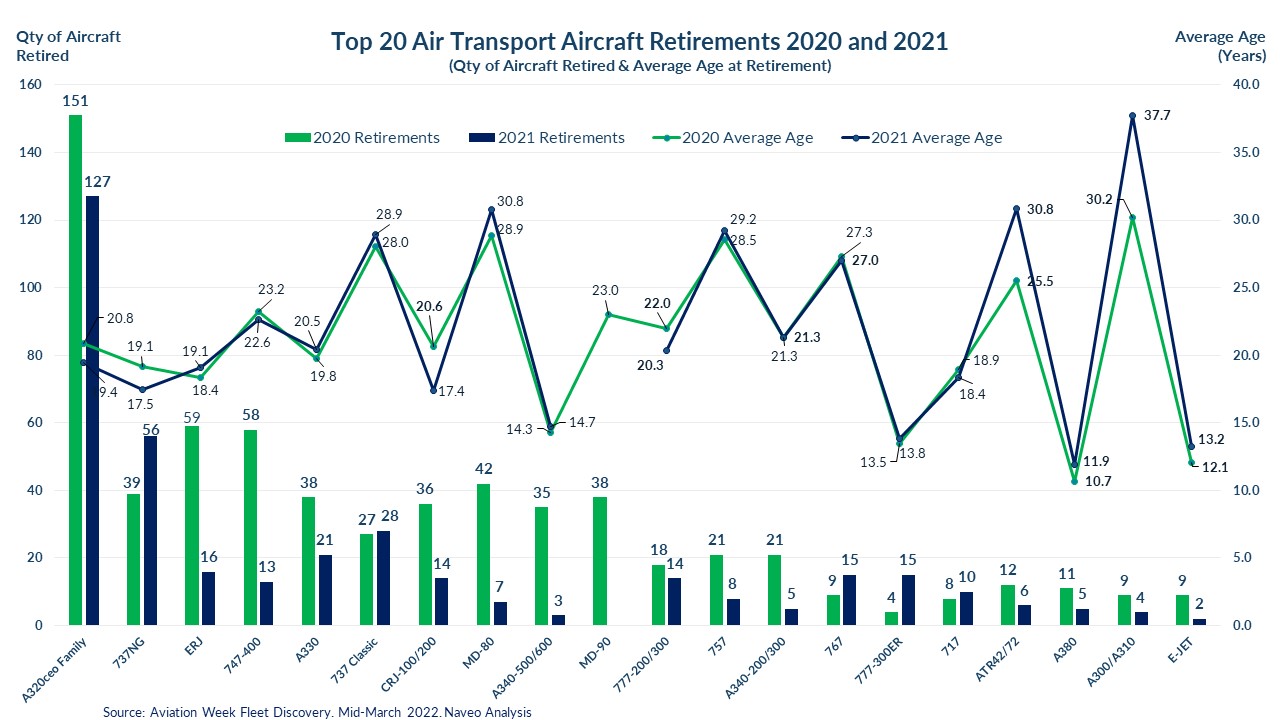
Below are the top 20 aircraft families that were retired in 2020/2021. The average age of the ~738 aircraft retired in 2020 was 23.12 years.  For the 429 retired in 2021, the average age was similar at ~23.09 years.

The 19 777-300ERs retired in 2020/2021 had an average age of only 13.8 years. The 16 A380s retired had an average age of 11 years. The 11 E-Jets retired had an average age of 12.3 years. Many of these aircraft were purchased by Private Equity-backed USM providers for teardown, engine green time leasing, and part reclamation.

However, as can be seen, there were some older aircraft retired (e.g., MD80s with an average age of 28.9/30.8 years) and 737 Classics (28.0/28.9 years).

There were also a smaller number of younger aircraft that retired prematurely compared to the expected economic life when they rolled off the production line.

Of the 95 737NGs retired in 2020/2021, 68 were 737-600/700s, smaller aircraft and less popular than the larger 737-800s.  These aircraft were typically harvested for their engines and components (common to larger 737NGs).

Of the 278 A320ceo family retired in 2020/2021, 117 were the smaller A318/A319, and 137 were A320-200s.